
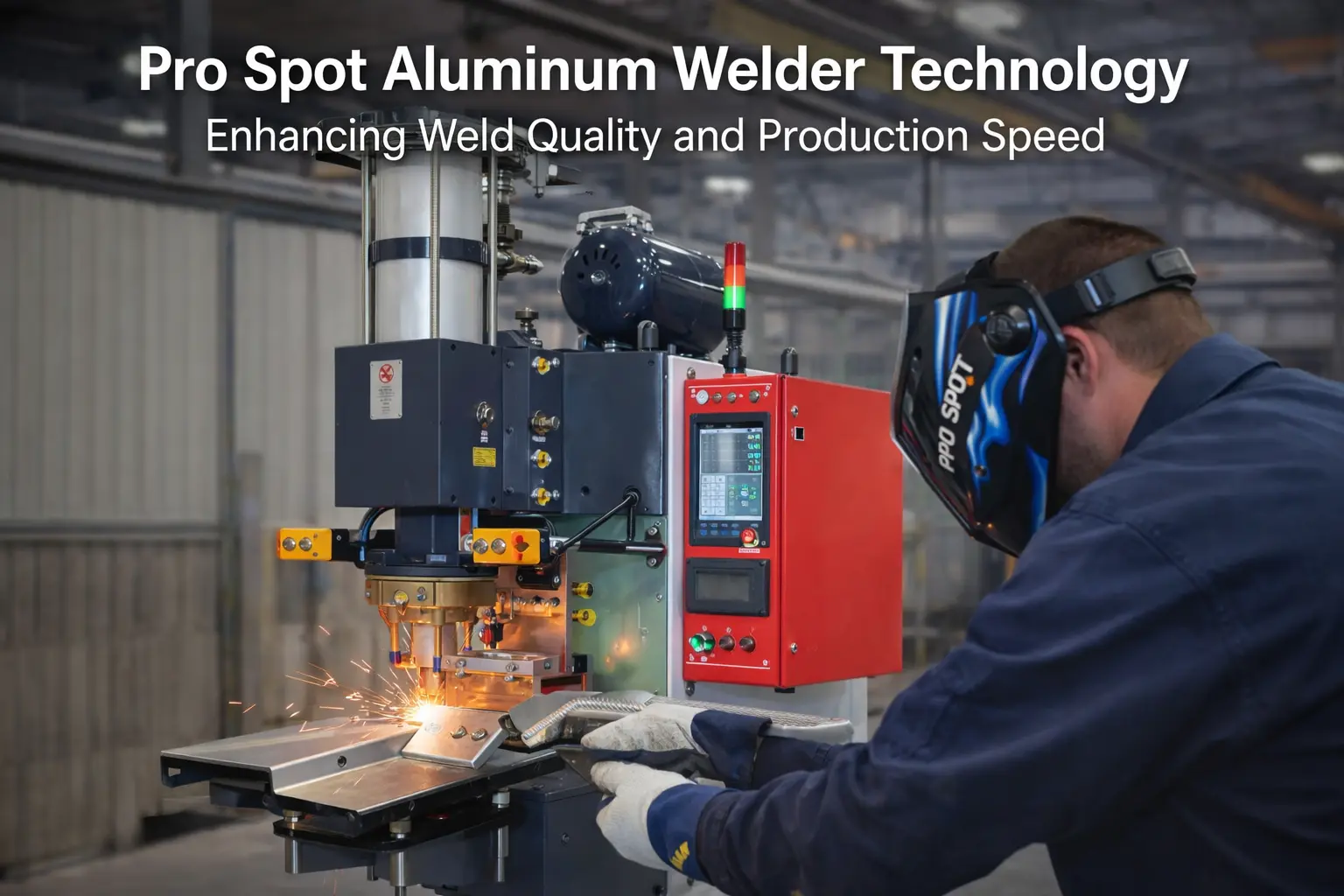
In modern automotive manufacturing, precision, efficiency, and repeatability are non-negotiable. An automotive spot welder is at the heart of vehicle assembly lines, joining sheet metals with speed and accuracy that manual methods simply cannot match. For manufacturing engineers, OEMs, and automation integrators, understanding the technology, applications, and best practices behind spot welding is critical for optimizing production and ensuring long-term quality.
Heron Welder, a global leader in industrial welding solutions, offers a full suite of spot welding systems and automated production lines engineered for the demanding automotive sector.
What is an Automotive Spot Welder?
An automotive spot welder is a type of resistance welding machine specifically designed to join two or more metal sheets at discrete points. The process relies on the principle of electrical resistance heating:
-
Two copper alloy electrodes clamp the metal sheets together.
-
A high current passes through the electrodes, generating heat at the interface due to the material’s resistance.
-
The localized heat melts the metal, forming a small “nugget” that solidifies under pressure, creating a strong metallurgical bond.
This method ensures minimal distortion, high repeatability, and suitability for thin automotive steels and advanced high-strength steels (AHSS).
Key Applications in Automotive Manufacturing
Spot welding is the backbone of automotive body assembly. Some of the most common applications include:
-
Body-in-white (BIW) assembly: Joining panels such as doors, hoods, and roof sections.
-
Chassis fabrication: Ensuring structural integrity of frames and cross-members.
-
Electrical enclosures and brackets: Attaching thin metal components with precision.
-
Hybrid and EV manufacturing: Spot welding lightweight aluminum and mixed-material assemblies.
By leveraging advanced MFDC (Medium Frequency Direct Current) spot welders, manufacturers can optimize welding cycles, reduce energy consumption, and improve nugget consistency even in complex geometries.
Automotive Spot Welding vs. Other Joining Methods
While spot welding dominates the automotive industry, several alternatives exist. Understanding the differences helps engineers select the right technology for each application:
| Joining Method | Advantages | Limitations |
|---|---|---|
| Spot Welding | Fast, repeatable, strong, minimal distortion | Limited to accessible joint points, mostly sheet metals |
| Self-Pierce Riveting (FSPR) | Excellent for mixed materials and aluminum | Slower cycle, higher component cost |
| Laser Welding | Precise, minimal heat-affected zone | High equipment cost, complex safety measures |
| Clinching | No consumables, suitable for thin sheets | Lower tensile strength than welded joints |
Heron Welder provides not only state-of-the-art spot welders but also complementary solutions like FSPR systems and clinching machines, giving OEMs flexibility in multi-material assembly lines.
Selecting the Right Automotive Spot Welder
Choosing the ideal spot welding solution requires careful consideration of:
-
Material thickness and type: Steel, stainless steel, aluminum, and AHSS require different current settings and electrode designs.
-
Weld size and spacing: Determine electrode type and force requirements.
-
Production volume: High-volume lines benefit from automated, robot-integrated spot welders.
-
Integration with automation: Spot welders must interface with robotic arms, conveyors, and quality monitoring systems.
Heron’s portfolio includes manual, semi-automatic, and fully automated spot welding solutions. Their machines feature precise control, adaptive weld parameters, and advanced monitoring for consistent quality across millions of cycles.
Best Practices for Automotive Spot Welding
To maximize productivity and quality, engineers should follow these key guidelines:
-
Regular electrode maintenance: Keep tips clean, shaped, and free from wear to maintain consistent nugget size.
-
Optimal weld scheduling: Adjust current, force, and time based on material type and thickness.
-
Monitor process parameters: Use sensors and data logging to detect anomalies early.
-
Integrate with robotics: Ensure precise electrode placement and repeatable clamping for high-volume production.
-
Test and validate welds: Perform destructive and non-destructive testing to confirm joint strength and durability.
Heron Welder systems incorporate real-time quality monitoring and adaptive welding algorithms, ensuring every weld meets stringent automotive standards.
Advantages of Partnering with Heron Welder
By choosing Heron Welder, manufacturers gain access to:
-
Expertise in industrial welding: Decades of experience in resistance welding, clinching, and FSPR systems.
-
Customized automation solutions: Fully integrated robotic welding lines tailored to your production needs.
-
Global support and service: From installation to preventive maintenance, Heron ensures optimal uptime.
-
Energy-efficient and durable equipment: Reduce operational costs while maintaining high throughput.
Whether building conventional vehicles, electric cars, or advanced EV architectures, Heron provides scalable solutions for every assembly challenge.
FAQs about Automotive Spot Welding
1. What metals can an automotive spot welder join?
Most spot welders can handle mild steel, stainless steel, and aluminum, including AHSS and mixed-material assemblies with the right electrodes and settings.
2. How long does a typical spot weld cycle take?
Modern MFDC spot welders can complete a weld in 0.2–0.5 seconds, depending on material thickness and machine configuration.
3. Can spot welding be automated?
Yes, spot welding is commonly integrated with robotic arms and automated production lines for high-volume, precise operations.
4. How is weld quality monitored?
Advanced machines use real-time sensors to measure current, force, and nugget formation, alerting operators to deviations immediately.
5. What is the difference between spot welding and FSPR?
Spot welding melts the metal sheets, forming a nugget, whereas FSPR mechanically pierces and joins sheets without melting, suitable for lightweight or dissimilar materials.
Conclusion: Optimize Your Automotive Production with Heron
An automotive spot welder is essential for modern vehicle assembly, providing speed, strength, and precision in joining sheet metals. With Heron Welder’s advanced resistance welding machines, automation expertise, and global support, OEMs and manufacturing engineers can achieve consistent quality, higher throughput, and reduced operational costs.
Ready to enhance your production line? Contact Heron Welder today to request a quote or consult with our experts for customized spot welding and automated welding solutions tailored to your automotive manufacturing needs.

 Arabic
 French
 Spanish
 Portuguese
 Deutsch
 Turkish
 Dutch
Dutch
 Italiano
 Russian
 Romaian
 Portuguese (Brazil)
 Greek
Greek