
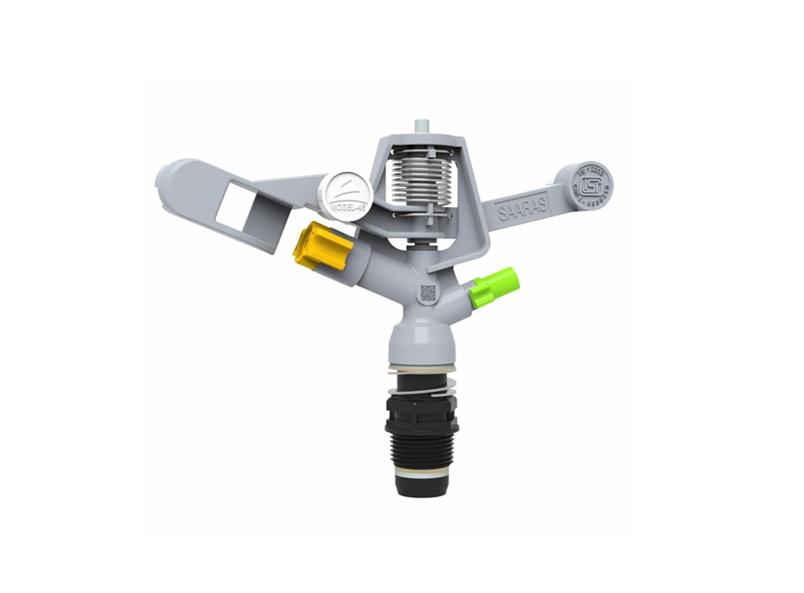
Most irrigation decisions are made upfront, based on cost, availability, and what’s familiar. But what really matters often shows up later. Maintenance, replacements, and how consistently the system performs over time.
That’s usually when the difference between materials becomes clearer. And in many cases, plastic impact sprinklers end up being the more practical choice, not just initially, but over an entire season.
Where plastic impact sprinklers make a difference first ?
The first thing most people notice is how smoothly the system runs over time. Metal sprinklers can start off strong, but as they stay exposed to water and weather, small changes begin to show. Movement may not feel as free, or parts might need cleaning more often.
With plastic impact sprinklers, that change happens much more slowly. The material doesn’t react the same way to water or minerals, so the sprinkler keeps moving the way it should for longer. It’s not something dramatic. Just fewer small issues showing up again and again.
Corrosion is not a small issue
Water in irrigation is rarely clean. It carries minerals, sometimes salts, and other particles depending on the source. Metal components deal with all of this directly, and over time, that interaction builds up. Even with coatings, some level of wear is hard to avoid.
Plastic handles this differently. It doesn’t corrode, and it doesn’t react in the same way. That’s one of the reasons why plastic impact sprinklers tend to last longer without needing frequent attention, especially where water quality isn’t consistent.
Handling and installation stay easier
This is something you really feel during setup. Metal sprinklers are heavier. Moving them around the field, adjusting layouts, or installing multiple units takes more effort than expected.
Plastic versions are lighter, and that changes how easy it is to work with them. You can shift positions, adjust spacing, or replace a unit without it turning into a task on its own. Over time, that convenience matters more than it seems at the beginning.
Performance under everyday conditions
No field runs under perfectly steady pressure all the time. There are always small variations depending on supply, usage, or layout. A good Impact sprinkler should continue working without getting affected by these changes too quickly.
Plastic models today are designed to handle a range of pressure conditions. Many of them keep running even when pressure drops a bit, still turning properly and covering the area like they should. That kind of flexibility keeps the system steady, even when conditions are not ideal.
Less maintenance, fewer interruptions
One of the biggest differences shows up in how often you need to step in. Metal sprinklers can gradually need more attention. Cleaning, checking movement, or dealing with parts that don’t move as freely as before.
With plastic impact sprinklers, you don’t end up dealing with those small stoppages as often. There’s less buildup inside, and things just keep moving more smoothly, so parts are less likely to get stuck.
It doesn’t eliminate maintenance completely, but it spreads it out. You’re not dealing with the same issue every few days.
Consistency in water distribution
At the end of the day, the goal is simple. Water should reach evenly across the field. When movement stays smooth and uninterrupted, distribution stays more uniform.
Plastic components, especially when paired with well-designed nozzles, help maintain that consistency. Features like colour-coded nozzles or stream control make it easier to manage coverage without constant adjustment.
And over time, this shows up clearly in how evenly crops grow across the field. How this shift is showing in practice
Across different setups, the preference is slowly shifting.
Many farmers start with metal because it’s familiar. But after a season or two, they begin noticing where time and effort go. At Automat, the approach has been to focus on systems that stay reliable in real field conditions. That means looking at how materials behave over time, not just how they perform when new.
Plastic fits naturally into that thinking. It keeps things simple and steady, which is what most setups need.
Bringing it all together
Choosing between materials might not feel like a big decision at first. But over time, it affects how often you step in, how evenly water spreads, and how long the system keeps working without trouble.
With plastic impact sprinklers, a lot of those small concerns settle down. The system runs more smoothly, and you spend less time fixing things.
Conclusion
Irrigation systems are not just about getting water into the field. They’re about keeping that process steady day after day. When the equipment supports that, everything else becomes easier to manage.
That’s why more setups today are leaning towards plastic impact sprinklers. Not because they’re new, but because they hold up better where it actually matters, out in the field.

 Arabic
 French
 Spanish
 Portuguese
 Deutsch
 Turkish
 Dutch
Dutch
 Italiano
 Russian
 Romaian
 Portuguese (Brazil)
 Greek
Greek