
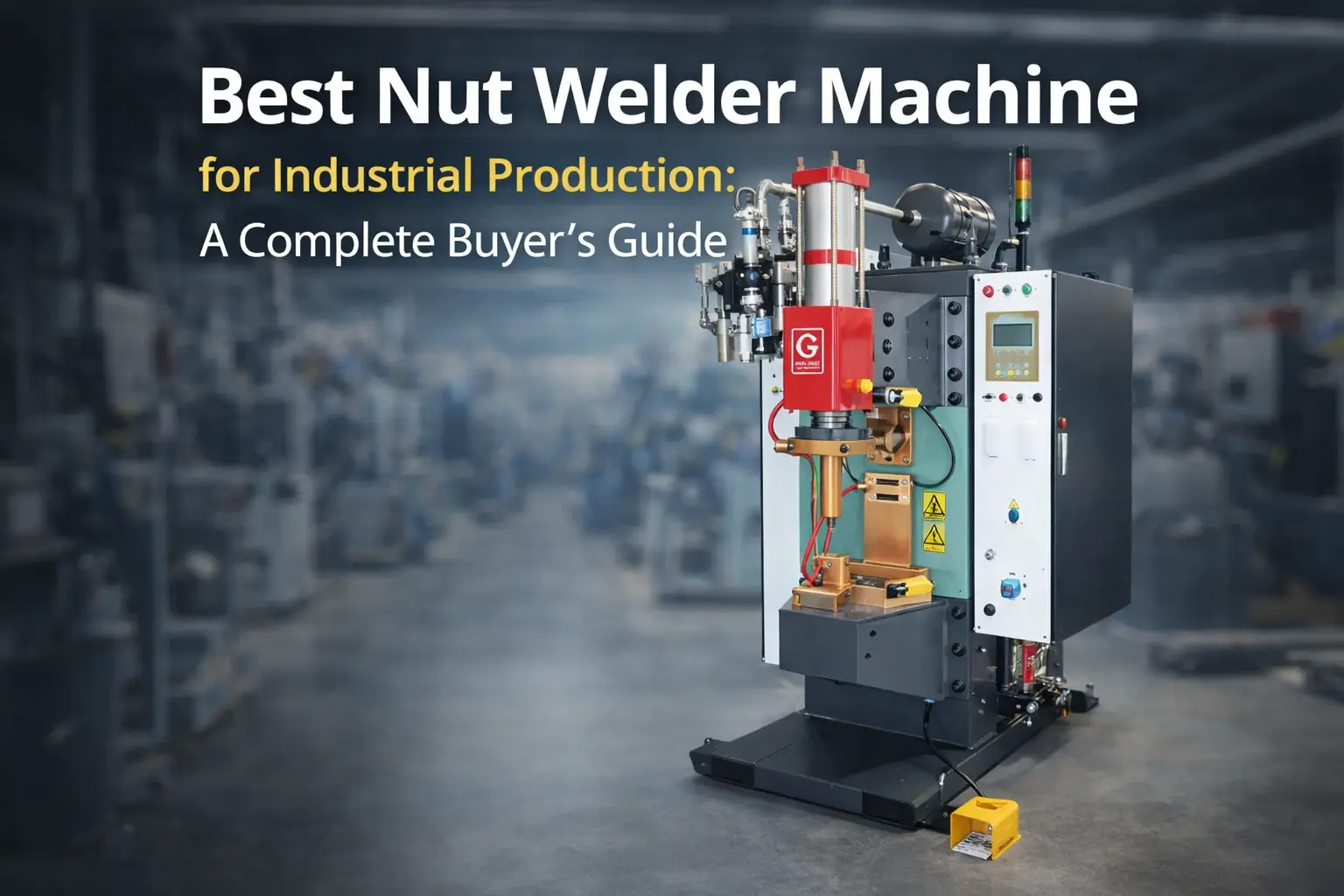
In today’s high-speed manufacturing environment, joining components efficiently, accurately, and reliably is critical. Among the versatile metal-joining technologies, the nut welder has emerged as a vital tool for automotive, appliance, electronics, and industrial fabrication sectors. Heron Welder, a global leader in industrial welding equipment, offers advanced nut welding solutions that combine precision, speed, and automation compatibility, helping factories boost productivity while maintaining stringent quality standards.
What is a Nut Welder?
A nut welder is a specialized resistance welding machine designed to attach nuts securely to metal surfaces. Unlike traditional mechanical fastening, nut welding creates a metallurgical bond, ensuring consistent electrical conductivity, structural integrity, and vibration resistance.
Nut welding relies on the principle of resistance spot welding, where a high-current electrical pulse passes through the nut and sheet metal interface. The localized heat melts the base metal and the nut, forming a strong weld upon cooling. Modern nut welders integrate pneumatic or servo-driven electrodes and precise controllers to optimize weld quality and reduce rework.
Key Principles of Nut Welding
Understanding the fundamentals of nut welding helps engineers select the right equipment and parameters:
- Current Intensity and Duration: Proper control of welding current and pulse duration ensures the nut melts just enough to form a secure bond without deforming surrounding metal.
- Electrode Pressure: Uniform pressure applied by the welding gun maintains consistent contact and prevents weak or misaligned welds.
- Material Compatibility: Nut welders are suitable for various metals, including steel, stainless steel, and aluminum, but electrode type and settings must match the material properties.
- Cooling and Cycle Efficiency: Advanced systems incorporate cooling channels or water-cooled electrodes to sustain high-speed production without overheating components.
Heron’s nut welders combine these principles with automated monitoring, providing real-time feedback to ensure consistent weld quality across large production volumes.
Applications of Nut Welders
Nut welding is indispensable in industries where threaded fasteners must be attached efficiently:
- Automotive Manufacturing: Attaching nuts to chassis panels, engine components, and structural assemblies for rapid assembly line integration.
- Appliance Production: Securing nuts on washing machines, refrigerators, and HVAC components with precision and minimal distortion.
- Electronics and Enclosures: Welding nuts on metal casings for control panels and electrical cabinets.
- Metal Fabrication: Integrating nuts into structural frames, industrial equipment, and machinery assemblies.
Heron Welder’s machines support both manual and fully automated production lines, making them ideal for OEMs and system integrators looking to scale operations without compromising quality.
Nut Welder vs. Traditional Fastening Methods
Choosing a nut welder over conventional methods offers several advantages:
| Feature | Nut Welder | Traditional Fastening |
|---|---|---|
| Speed | Milliseconds per weld | Several seconds per fastener |
| Consistency | Uniform metallurgical bond | Dependent on operator skill |
| Automation | Fully compatible with robotic arms | Manual labor-intensive |
| Durability | High vibration resistance | Potential loosening over time |
| Cost Efficiency | Reduces rework and hardware costs | Material cost plus assembly time |
By integrating Heron’s nut welding systems, manufacturers achieve reliable, high-speed assembly while reducing labor dependency and material wastage.
Best Practices for Using a Nut Welder
- Correct Nut Selection: Match nut size, material, and thickness to the welding system specifications.
- Electrode Maintenance: Regularly clean and dress electrodes to prevent inconsistent welds and extend service life.
- Parameter Testing: Conduct sample welds to fine-tune current, pressure, and timing settings for optimal results.
- Automation Integration: Use robotic arms or linear actuators for repeatable positioning, especially in high-volume lines.
- Safety Compliance: Ensure operators follow electrical safety protocols and wear protective equipment during manual welding.
Heron Welder provides comprehensive training and support, helping factories implement best practices seamlessly for maximum productivity.
Why Choose Heron for Nut Welding Solutions
Heron Welder stands out as a trusted partner for industrial welding due to:
- Advanced Technology: Machines equipped with MFDC (Medium-Frequency DC) or capacitor discharge capabilities for precise control.
- Automation Ready: Fully compatible with robotic integration and production line automation.
- Global Expertise: Decades of experience serving OEMs, automation integrators, and high-volume manufacturers.
- Customized Solutions: Tailored nut welding setups to meet unique production requirements, including multi-nut welding and hybrid assembly systems.
With Heron’s global support network and engineering expertise, manufacturers can reduce downtime, improve quality, and scale efficiently.
Frequently Asked Questions (FAQs)
1. What materials can be welded using a nut welder?
Nut welders are suitable for steel, stainless steel, and aluminum sheets, with machine settings adjusted to material thickness and conductivity.
2. Can nut welders be integrated into automated production lines?
Yes. Heron nut welders are designed for robotic integration, including gantry systems, articulated arms, and linear transfer lines.
3. How do I ensure weld consistency?
Consistent electrode maintenance, precise parameter control, and automated positioning are key. Heron systems provide real-time monitoring and feedback to maintain quality.
4. What industries benefit most from nut welding?
Automotive, appliance manufacturing, electronics, HVAC, and general metal fabrication all benefit from nut welding for speed, precision, and durability.
5. Is nut welding cost-effective compared to traditional fasteners?
Yes. Nut welding reduces labor costs, hardware costs, and rework, particularly in high-volume production environments.
Conclusion: Optimize Your Production with Heron Nut Welders
For manufacturers seeking precision, speed, and reliability, a Heron nut welder is a strategic investment. By integrating advanced welding technology with automation-ready systems, factories can achieve superior quality, reduce assembly times, and enhance operational efficiency.
Contact Heron Welder today to request a quote or consult with our engineering team about customized nut welding and automated production solutions tailored to your manufacturing needs.

 English
 Arabic
 French
 Spanish
 Portuguese
 Deutsch
 Turkish
 Dutch
Dutch
 Italiano
 Russian
 Portuguese (Brazil)
 Greek
Greek