
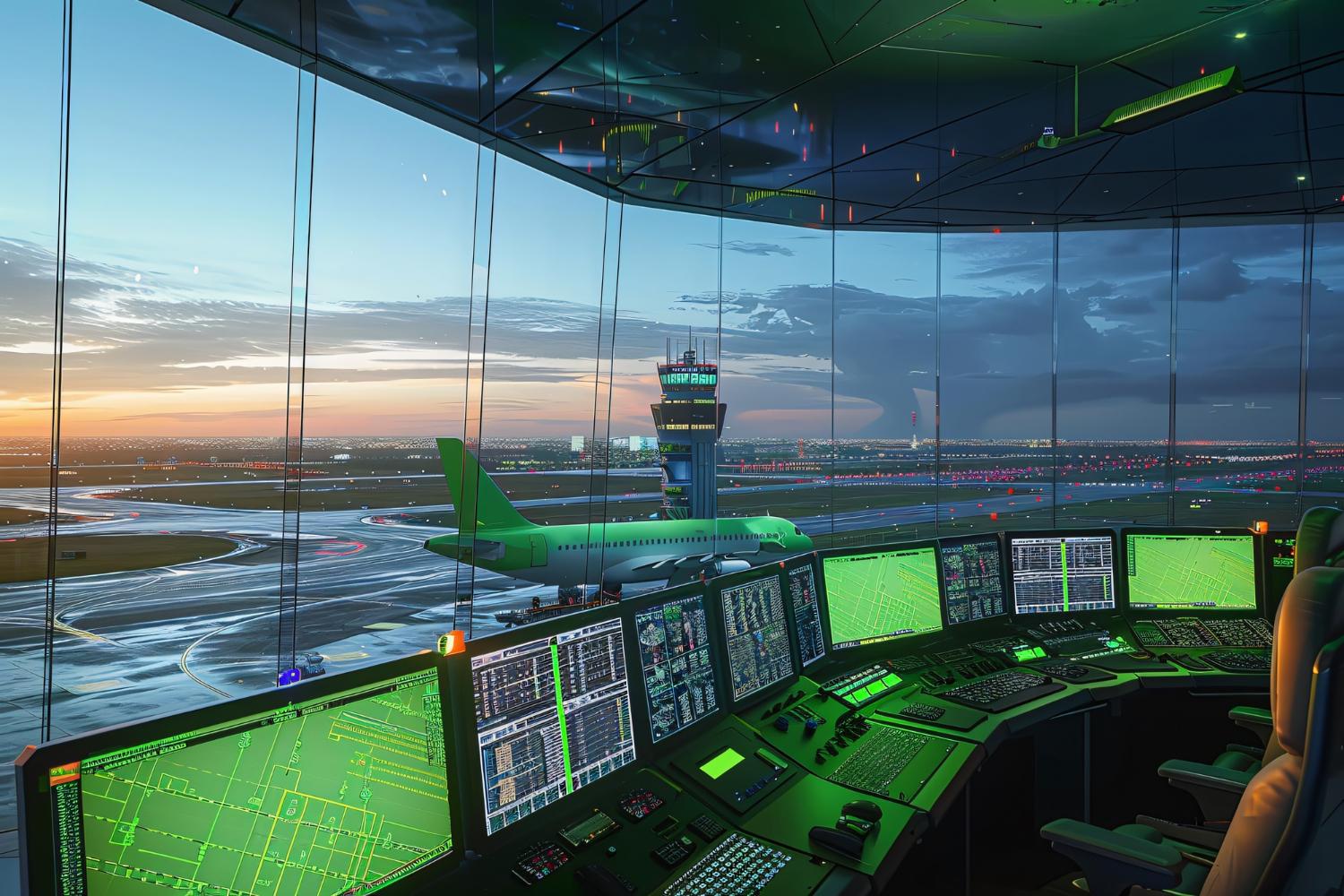
The modern airspace is a marvel of coordination, with thousands of aircraft weaving through the sky in a complex but orderly ballet. This incredible feat of logistics is built on a foundation of clear, reliable communication. At the heart of this system is a technology that has shaped aviation for nearly a century: Very High Frequency (VHF) radio.
The journey of VHF in Aviation is a story of innovation, charting a course from crackly, unreliable signals to the crystal-clear, digitally integrated systems of today. Understanding this evolution reveals how each advancement has directly contributed to making air travel the safest mode of transportation in the world.
This article traces the historical development of aircraft-to-ground communication. We will explore its early days, the shift to VHF, the introduction of digital enhancements, and the future of aviation voice technology. We will also examine how this evolution is reflected in the state-of-the-art infrastructure designed by Airport engineering Qatar.
The Early Days: From Morse Code to Voice
In the first decades of flight, pilots navigated by sight, following landmarks like railways and rivers. Communication with the ground was nonexistent. If a pilot ran into trouble, they were on their own. By the 1920s, early radio systems using Low and Medium Frequencies began to appear in aircraft. These systems, often using Morse code, were a revolutionary step forward but were plagued with problems.
The signals were susceptible to atmospheric interference, such as static from lightning, which could render them unintelligible. The equipment was heavy, bulky, and unreliable. It was a far cry from the instant communication needed for true air traffic control. The need for a clearer, more dependable solution was obvious.
The Great Leap Forward: The Adoption of VHF
The 1930s and 1940s marked a pivotal turning point with the introduction of Very High Frequency (VHF) radio. Operating in the 30-300 MHz range, VHF offered several distinct advantages over its low-frequency predecessors.
Clarity and Line-of-Sight
VHF signals are far less affected by atmospheric static, resulting in much clearer voice transmissions. This was a massive leap for flight safety, as it dramatically reduced the chance of a pilot mishearing a critical instruction from a controller.
Critically, VHF waves travel in a straight line—a property known as "line-of-sight." This means communication is limited by the horizon. While this sounds like a drawback, it became a key organizing principle for air traffic control. It allowed the same frequencies to be reused by different airports around the world without interfering with each other. This frequency reuse model is still the basis for air traffic management today.
By the end of World War II, VHF radio had become the undisputed standard for civil aviation, laying the groundwork for the structured, sector-based air traffic control system we know today.
Refining the System: Channel Spacing and Standardization
As air traffic grew exponentially in the post-war era, the skies became more crowded. The original VHF band began to run out of available channels. This led to the next major evolution: reducing the channel spacing.
Initially, VHF channels were spaced 100 kHz apart. This was later reduced to 50 kHz, and then again to 25 kHz, effectively doubling and then quadrupling the number of available channels. More recently, in Europe and other high-density regions, spacing has been further reduced to 8.33 kHz. This "narrowbanding" was a crucial step to accommodate the ever-increasing volume of air traffic.
This period also saw the standardization of aviation phraseology. With English established as the international language of aviation, a common set of words and phrases was developed to ensure instructions were clear and unambiguous, regardless of a pilot's native language.
The Digital Age: Integrating VHF with Modern Systems
While the core principle of VHF radio—transmitting an analog voice signal—has remained largely unchanged, the technology surrounding it has undergone a digital revolution. Modern communication systems are no longer just standalone radios; they are deeply integrated components of a larger digital ecosystem.
Voice Communication and Control Systems (VCCS)
In today's control towers, the old banks of radio equipment have been replaced by sleek, touch-screen VCCS consoles. These systems digitize the entire communication process. A controller can select a frequency, contact an aircraft, and patch in a phone call to an operations center, all with a few taps on a screen.
This integration reduces controller workload, streamlines workflows, and minimizes the potential for human error. It is a perfect example of how digital technology can enhance a trusted analog system.
Controller-Pilot Data Link Communications (CPDLC)
The evolution of VHF in Aviation has also been about knowing when not to use it. Routine messages, such as requesting a change in altitude or receiving a weather update, can clog up busy radio frequencies. CPDLC, a form of text messaging between the cockpit and the ground, was developed to handle these non-urgent communications.
This allows the VHF voice channels to remain open for what they do best: time-critical, tactical instructions. The future is a hybrid model where data links manage routine tasks, while voice remains the tool for immediate action and emergencies.
A Model of Modern Implementation: Airport Engineering in Qatar
The evolution of aviation communication is not just a historical timeline; it is visible today in the infrastructure of the world's most advanced airports. The work carried out by Airport engineering Qatar in developing Hamad International Airport (HIA) showcases the pinnacle of modern VHF system design.
As a major global hub, HIA handles an immense volume of traffic in a concentrated airspace. The communications infrastructure must be flawless.
Engineering for Total Reliability
Engineers in Qatar have designed a VHF system with multiple layers of redundancy. Every primary radio transmitter has a "hot standby" backup that takes over instantly if a fault is detected. The entire system is supported by uninterruptible power supplies (UPS) and massive on-site generators, ensuring that controllers can talk to pilots even during a total power failure. This focus on resilience is a direct lesson learned from decades of aviation history.
Strategic Integration and Coverage
The VCCS at HIA is fully integrated with radar and flight data systems. When a controller selects an aircraft on their screen, the system can automatically suggest the correct frequency, a feature that enhances efficiency and safety.
Furthermore, a significant focus of Airport engineering Qatar is ensuring 100% radio coverage. Using advanced 3D modeling, engineers strategically place antenna towers to eliminate any "dead zones" on the vast airport surface where buildings might block signals. This meticulous planning ensures that a pilot taxiing to a remote stand is in constant, clear contact with ground control. Remote radio sites are also deployed to extend coverage over the Persian Gulf, providing seamless communication for aircraft far from the airport.
The Enduring Legacy of VHF
From its early adoption to its current digitally-enhanced form, VHF in Aviation has been a constant and vital presence in the cockpit and the control tower. It has evolved from a simple voice radio into a highly reliable, deeply integrated system that forms the backbone of global air safety.
The story of its development is a testament to the aviation industry's relentless pursuit of safety and efficiency. As demonstrated by the sophisticated implementation in hubs like HIA, the principles of clear voice communication are more relevant than ever. In an industry where there is no margin for error, the simple act of talking remains the most powerful safety tool we have.

 Arabic
 French
 Spanish
 Portuguese
 Deutsch
 Turkish
 Dutch
Dutch
 Italiano
 Russian
 Romaian
 Portuguese (Brazil)
 Greek
Greek