
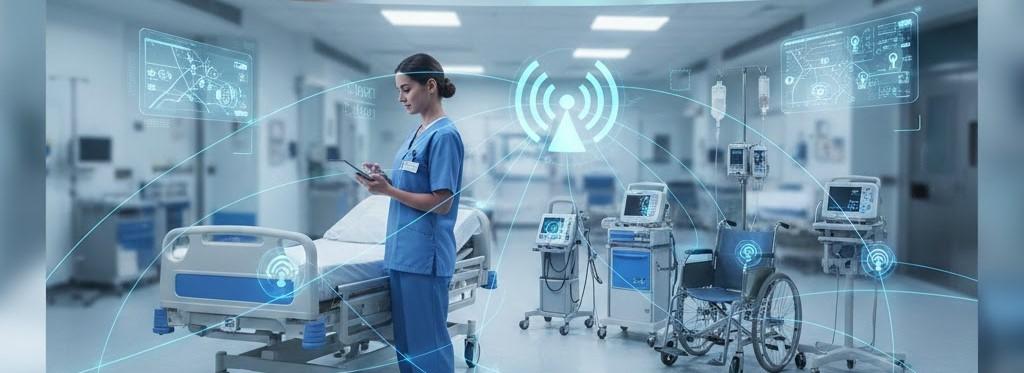
Patient safety and data privacy are critical in the competitive nature of the healthcare setting today. The Health Insurance Portability and Accountability Act (HIPAA) is the most important document that safeguards confidential patient data. Although it is commonly linked to digital records and cybersecurity, the physical protection requirements of HIPAA apply to the equipment upon which the patient care is provided.
This is where Radio-Frequency Identification (RFID) asset tracking serves not only as a tool of operation, but also as a potent support in the achievement and sustainability of HIPAA compliance. Choosing the right RFID technology in healthcare can seriously impact the health sector.
The Security Rule of HIPAA requires administrative, physical, and technical safeguards of the Protected Health Information (PHI). Physical controls particularly demand the policies to regulate the delivery and transport of hardware and electronic media in and out of facilities with PHI.
Uncontrolled medical devices, including diagnostic laptops, portable ultrasounds, medication carts, or even hard disks on imaging machines, can be a major weakness when lost or stolen, and this will cause a devastating breach.
RFID Tracking Addresses HIPAA Concerns
a) Loss Prevention
RFID systems can offer real-time monitoring of the location of important assets. Knowing the precise location of all equipment in the hospitals will allow them to avoid the presence of devices with PHI out of the secured environment, which will significantly decrease the chances of physical theft or misplacement.
b) Custody Auditing
Prestigious RFID systems record the identity, date, and duration of checkout of a device. This will form an automatic audit trail for the fulfillment of the HIPAA accountability requirement. Administrators are able to track device history in case an investigation takes place accurately.
c) Hardware Source
Tracking makes sure that devices that are to be serviced or discarded have been properly maintained. This eliminates the possibility of having a decommissioned laptop with unencrypted patient information being mishandled, which is usually a major reason behind compliance failures.
d) Risk Analysis
HIPAA mandates periodical risk analysis. RFID information is a tangible data on the use of assets, trends in their movement, and security breaches to shape a risk management approach that would be data-driven.

What are Some Important Considerations You Must Focus on During Implementation?
a) Scope of Tracking Facility
Discover all PHI storing, processing, or transmitting devices. This is not limited to computers but also to biomedical equipment that has internal storage.
b) Importance of Integration
The RFID system is most effective when it is integrated with your current Hospital Information System (HIS) and security measures, generating an ecosystem.
c) Policy
There is no single technology that can work. New institutional policies should govern the correct methods of handling assets and RFID governance mechanisms. We must focus on RFID automation more to make things better in the future.
Tips that Will Help You in A Compliant RFID Deployment
- Start with tagging the assets with the highest probability of holding sensitive data or being mobile (e.g., COW carts, portable scanners).
- Select RFID tags (passive because of their cost-effectiveness, active because of real-time tracking) and the readers that are appropriate to your facility in size and construction.
- Virtual boundaries, with software. Get real-time notification of a tagged asset being left in a restricted area, such as a public exit.
- All personnel must be informed of why asset tracking is a privacy mandate, and not a mere inventory management tool. Understanding brings about
- Document your security efforts with the system your security efforts, and this is an important step to show due diligence in the event of a HIPAA audit.
RFID-tracking of vital medical equipment is a preventive measure towards a strong HIPAA implementation. It allows you to turn the physical asset management into a logistical challenge into a strategic part of your privacy protection program.
RFID technology grants healthcare providers the ability to concentrate on the main purpose of their organization, which is patient care, and to be sure that they are taking adequate care of the physical health of their patients as well as their data security due to the ability of RFID technology to stop breaches at the hardware level, create audit trails that cannot be refuted, as well as allow them to conduct thorough risk mitigation measures.

 English
 Arabic
 French
 Spanish
 Portuguese
 Deutsch
 Turkish
 Dutch
Dutch
 Italiano
 Russian
 Romaian
 Portuguese (Brazil)